
Ball Valve vs. Butterfly Valve: Which One Should You Choose?
DescriptionBall Valve vs Butterfly Valve
Selecting the appropriate industrial valve is necessary. This is to ensure efficiency and reliability in controlling fluid flow and maintaining safety. Nevertheless, choosing one of these Industrial Valve Types relies on a number of parameters. This includes pressure, media type, pipeline diameter, working conditions, and others.
What Is a Ball Valve?
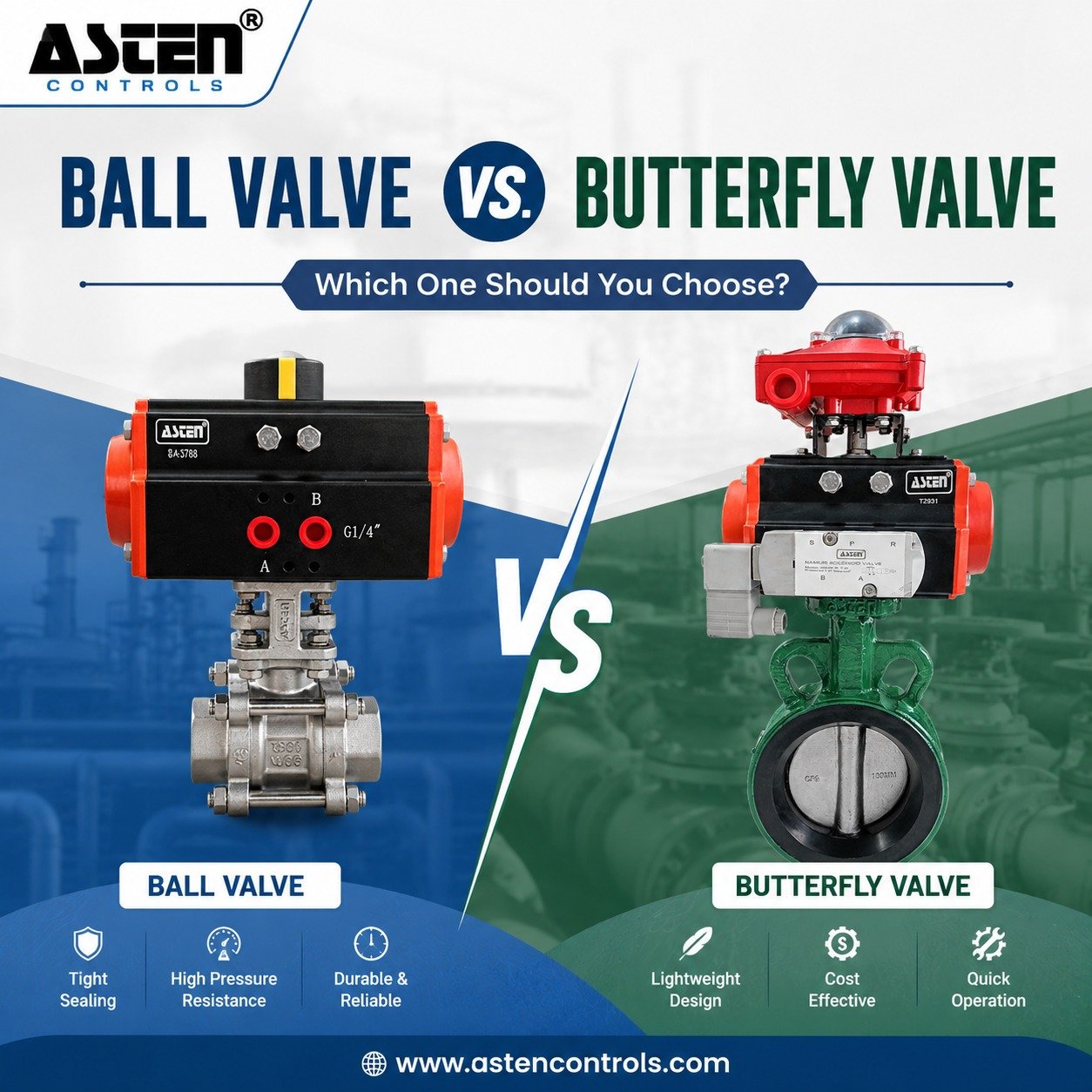
A ball valve is a type of quarter-turn valve. This comes with a spherical ball that has an opening bored into it. The ball is rotated by 90 degrees to open and close the flow path. This is to achieve efficient shut-off or opening. An Industrial Ball Valve is used where perfect seal and high-pressure resistance are needed.
What Is a Butterfly Valve?
An Industrial Butterfly Valve is a quarter-turn valve which works through a disk fitted on a rotating shaft. The disk is turned at 90 degrees to either open or close the flow passage. An Industrial Butterfly Valve is a suitable choice for large pipelines where weight and cost considerations take precedence.
How Does a Ball Valve Work?
Construction
A ball valve comprises a valve body, ball, stem, seats, seals, and operating handle. The ball rotates on resilient seats for secure sealing.
Principle of Operation
Turning the handle by 90 degrees ensures that the hole within the ball lines up with the pipeline allowing fluid flow. Inverting the handle again ensures that the solid side of the ball blocks the flow path of the fluid.
Features
The ball valve provides full-port flow. It comes with low pressure drop, excellent sealing, fast response time, and automation capability.
How Does a Butterfly Valve Work?
Structure
A butterfly valve consists of a valve body, rotating disk, stem, seat, and actuator mechanism. The disk is located in the flow passage and is used to regulate or control the fluid flow.
Mode of Functioning
The disk turns 90 degrees to open and close the valve. In contrast to the ball valve, even when opened, the disk remains partly in the flow passage, which causes some restriction in flow.
Characteristics
Butterfly valves are very compact and lightweight. They are most suited for large diameter pipes. They have fast response time and can be operated manually, pneumatically, or electrically.
Advantages of Ball Valves
Bubble-Tight Closure
Among many other advantages, ball valves have excellent sealing capabilities and provide bubble-tight shut off that cannot tolerate any leakage in the system.
High Pressure
The ball valve performs admirably well at very high pressures and tough working environments such as oil and gas processing industries.
Long Service Life
As a result of reduced parts and tough sealing materials, ball valves last longer without compromising their performance throughout the repeated operation cycles.
Minimal Leakage
Accurate seals and seats in ball valves ensure minimal leakage both internally and externally.
Quick Quarter Turn Opening
Ball valves belong to the family of Quarter Turn Valves. Thus, they only need a quarter turn to open completely.
Advantages of Butterfly Valves
Light Weight
They are lighter in weight than ball valves of the same size making them easier to transport, install, and maintain.
Cost Savings
Due to simple design requiring less material, butterfly valves are inexpensive compared to other valves, especially where big pipeline systems are involved.
Small Installation Area
Compared to ball valves, butterfly valves occupy smaller installation areas and are therefore ideal in applications with little room on the pipeline.
Suitable for Big Pipe Sizes
Big pipes are mostly fitted with butterfly valves due to costly manufacture and installation of ball valves of the same sizes.
Easy Maintenance
Most butterfly valves contain few parts that facilitate easy inspection and maintenance of seats/seals.
Ball Valve Applications
Oil & Gas
Industrial Ball Valves are highly popular in the Oil and Gas Industry Valves application owing to their reliability during shut-off operations under extreme pressure and hazardous conditions.
Chemicals
Chemical factories use ball valves to handle corrosive chemicals, solvents, acids, and other chemicals without leakage.
Water Treatment
The Ball Valves control the flow of water. It is used in filtration systems, pumping stations, and treatment plants.
Food and Beverage
Food processing companies use Sanitary Ball Valves. This is for handling beverages, dairy products, edible oils, and cleaners.
HVAC Systems
The HVAC systems use ball valves for the efficient shut-off of pipelines and equipment.
Marine Industry
Corrosion-resistant ball valves are used by the Marine Industry for reliable performance in harsh environments.
Butterfly Valve Applications
Water Distribution
The Butterfly Valve finds use in Water Pipeline Valves applications due to its lightweight nature and suitability for large diameter pipelines.
Fire Protection
Fire protection installations use butterfly valves as isolation devices and for maintenance of sprinkler lines and fire fighting pipes.
Power Generation
Utility pipelines and water cooling systems of power plants tend to use butterfly valves due to their compactness.
Irrigation
Water pipelines for agricultural irrigation can rely on butterfly valves because of their economical nature and convenient usage.
Wastewater Treatment
Wastewater treatment plants use butterfly valves for transportation of large amounts of liquid, mud, and process fluids.
Industrial Utilities
Compressed air, cooling water, and utilities used in industrial facilities often use butterfly valves for reliable regulation of flows.
When Should You Choose a Ball Valve?
High Pressure Systems
Systems that have to work at high pressures and need reliable sealing can use only ball valves.
Critical Shut-Off Applications
Leakage-proof shut-off, emergency cut-off or safety shut-off systems should use ball valves.
Aggressive Chemical Handling
Special materials such as stainless steel, duplex steel and PTFE seats enable ball valves to deal with aggressive fluids.
Gas Applications
Gas systems have to be leakage-proof and therefore ball valves would be ideal for them.
Chemical Processing
Chemical processing facilities usually opt for ball valves for safely controlling hazardous and corrosive process fluids.
When Should You Choose a Butterfly Valve?
Large Diameter Pipe Lines
Butterfly valves are perfect for large diameter pipelines where weight and installation costs become a matter of concern.
Water Distribution Systems
City water distribution systems prefer butterfly valves because of their efficient flow control over extensive distribution networks.
Budget-Friendly Project
Projects having limited budgets prefer butterfly valves because of the low cost of purchase.
Low Pressure Operation
Butterfly valves give efficient service in low and moderate pressure where there is no requirement for absolute shut-off.
Limited Space for Installation
Small valve body makes butterfly valves a good choice for installations having limited space around.
Factors to Consider Before Selecting a Valve
Type of Fluid
It needs to be assessed that the fluid being handled is water, chemical, steam, gas, slurry, or corrosive before the selection of the valve.
Operating Pressure
High-pressure systems require ball valves whereas butterfly valves can do well with low pressures.
Temperature
Operating temperature of the system should not affect the performance of the valve material, seat, and seal.
Size of Pipeline
Larger diameter pipelines will normally favour the butterfly valve because of reduced weight and lower installation cost.
Automating Needs
Either ball valves or butterfly valves may be used with pneumatic, electric or hydraulic actuators to allow for automated operations.
Why Choose Asten Controls?
We include our engineering expertise, quality raw materials, and precision manufacturing service to deliver reliable valve solutions for various industrial applications. Our wide range of ball valves, butterfly valves, gate valves, globe valves, and automated valve systems is developed as per international quality standards, ensuring best performance, leak-proof operation, and long life operation. Our expert support team is always ready to help you choose the right industrial valve for your various application requirements. Moreover, you also get timely delivery, continuous support and market leading price for each of our products. Choose Asten Controls for reliable and durable valves that maximize operational efficiency and long-term reliability.
Frequently Asked Questions
Which valve needs less maintenance?
Both types of valves need very little maintenance. Ball valves generally need less maintenance as a result of having a simple seal system while butterfly valves have an easy maintenance process thanks to being built to be compact and having fewer parts.
Can both valves be automated?
Yes, both ball valves and butterfly valves can be automated using electric, pneumatic and hydraulic actuators, making it easy for them to integrate with automated Process Control Valves.
Conclusion
Knowing the Difference between Ball Valve and Butterfly Valve is necessary when picking the appropriate valve to use in your industry. Ball valves work well in high pressure environments, crucial shut-off operations, gas operations, and chemical processes requiring leak-free performance. Butterfly valves are suitable for large diameter pipe lines, water supply systems, HVAC, irrigation among other uses.


