

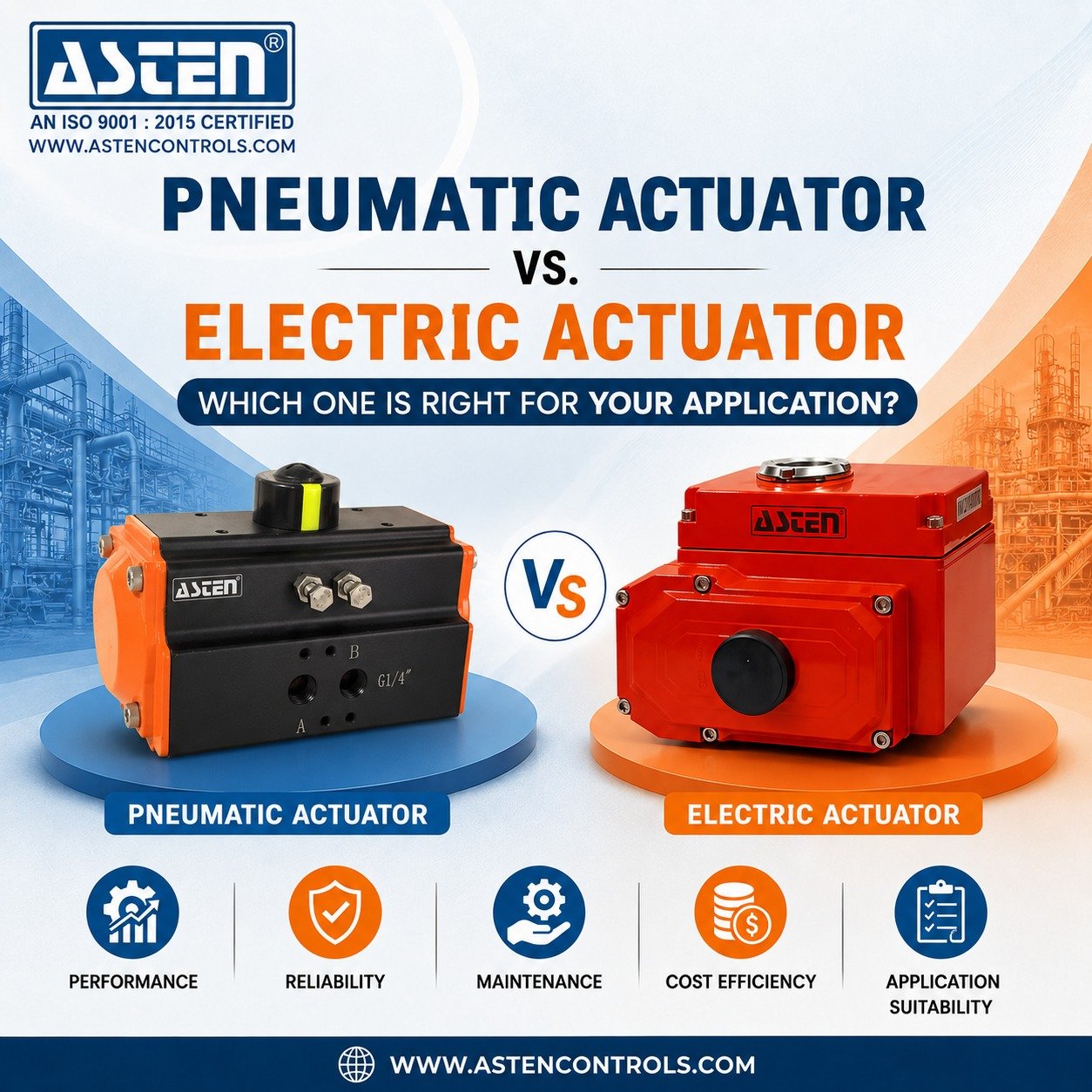
Pneumatic Actuator vs. Electric Actuator: Complete Comparison
DescriptionPneumatic Actuator vs Electric Actuator
Automation of processes has become an essential part of modern industries, as it allows improving efficiency, safety, and consistency of operations performed by machines. An essential element of automatic flow control is the valve actuator, which can be used when controlling any substance, from water or steam to chemicals, oil, and gas. There are many types of Industrial Actuators, but the most common ones are pneumatic and electric actuators. In this article, we will learn the difference between Pneumatic actuators and Electric actuators.
Introduction to Valve Actuators
What Is a Valve Actuator?
A valve actuator is a device that allows you to open, close, or position valves automatically. Instead of manually turning the valve, a pneumatic actuator or an electric actuator moves it using either air pressure or electric power. Valves are often operated with the help of actuators in Valve Automation Systems to increase efficiency and reduce manual labour.
Why Valve Automation Is Important?
The automated valve makes sure that fluid flows through at exact measures as required by various industries. It makes industries to reduce the cost of labour and improve the speed of response time.
Types of Industrial Valve Actuators
There are two types of actuators commonly used in the industrial process including Pneumatic Actuators and Electric Actuators. The Pneumatic Actuator works with compressed air while Electric Actuator works with electric motors which rotate valves. They both come in linear actuator and Quarter Turn Actuator to operate the ball valves, butterfly valves, plug valves, and all other automated valves.
What Is a Pneumatic Actuator?
Pneumatic Valve Actuator uses compressed air to produce mechanical movement. They are commonly used in processes where there is a need for quick response and frequent cycles.
Operation of Pneumatic Actuators
There is compressed air that comes inside the actuator cylinder and produces pressure on either piston or diaphragm. The compressed air opens or closes the valves through the movement of the actuator shaft. Once the air pressure is changed or released, it resets the actuator to its initial stage or moves it in the opposite direction.
Advantages
The advantages of pneumatic actuators include fast action, high reliability, simple design, and high durability. Pneumatic actuators are ideal for areas that are hazardous due to the risks of ignition of electric components.
Disadvantages
The pneumatic actuator needs to have a constant source of clean dry compressed air which can add up to the amount of infrastructure needed. Also, the accuracy of positioning is not high without some control accessories.
What Is an Electric Actuator?
An Electric Valve Actuator works with the help of an electric motor and gear arrangement to perform the automated action of the valve. They find a wide range of applications where accurate positioning, programming, and monitoring are needed.
Working Principle
The actuator receives the command from the control system as an electric signal, which causes rotation of the motor through the gearbox to develop the required torque for valve opening and closing.
Components of Electric Actuators
Electric actuators consist of an electric motor, gearbox, control board, torque sensors, limit switches, position indicators, manual override, and weatherproof enclosure. Some electric actuators come with communication modules to communicate in industrial automation networks.
Benefits of Electric Actuators
Accuracy of position, smooth movement, programming capability, compatibility with PLC & SCADA are few of the benefits offered by electric actuators. They are well suited for Industrial Automation Solutions that involve intelligent monitoring and diagnostics.
Drawbacks of Electric Actuators
The main drawback of electric actuators is their slower speed than pneumatic actuators. Electric actuators need a reliable source of power and they may require explosion-proof housing in case of hazardous environment.
Pneumatic Actuator vs Electric Actuator: Side-by-Side Comparison
Feature Pneumatic Actuator Electric Actuator
Power Source Compressed Air Electric Power
Speed Faster Moderate
Accuracy Good Excellent
Torque Control Moderate Precise
Installation Requires Air Supply Requires Electrical Supply
Maintenance Moderate Low
Initial Cost Lower Higher
Operating Cost Depends on Air System Energy Efficient
Hazardous Areas Excellent Suitable with Certified Models
Automation Integration Good Excellent
Advantages of Pneumatic Actuators
Quick Response Time
One of the main advantages mentioned in any Pneumatic Actuator Comparison is its quick response time. As it operates quickly, it is useful for emergency shut-off valves and high cycle industrial applications.
Reliable Performance
With minimum electrical components and strong mechanical design, pneumatic actuators provide reliable performance under tough industrial operating conditions.
Safe Operation
As they operate on compressed air and not on electrical energy, pneumatic actuators are best suited for hazardous environments where flammable gas and vapour are present.
Simple Design
It makes the mechanical design simpler, and hence the installation, maintenance, and troubleshooting processes become easy.
Advantages of Electric Actuators
Positioning Accuracy
The Electric Actuator Comparison reveals the better positioning ability of electric actuators. They are able to stop in many positions; therefore, they are perfect for flow control purposes.
Energy Saving
These actuators need electricity only when operating; thus, their energy consumption is less than pneumatic actuators which need constant supply of compressed air.
Easier to Integrate with PLC/SCADA
Electric actuators are easily integrated with PLC, DCS and SCADA systems.
Less Maintenance Required
There are no compressors, pipelines of air and pneumatic equipment to maintain in electric actuators.
When Should You Choose a Pneumatic Actuator?
Oil & Gas Industry
The petroleum industry favours Pneumatic Valve Actuator systems since they can operate safely in dangerous conditions and respond quickly in emergency shutdowns.
Fast Opening/Closing Valves Operation
Applications where fast-valve actuation is required can be served with pneumatic actuators.
Hazardous Conditions
Pneumatic actuators may be installed in plants dealing with flammable substances or explosive gases to avoid ignition due to electricity.
Continuous Processing Industries
24 hours operating companies value the reliability and long lifespan of pneumatic systems.
When Should You Choose an Electric Actuator?
Water Treatment Facilities
Water treatment and purification plants prefer Electric Valve Actuator systems due to their accuracy, remote operation, and low maintenance.
HVAC Systems
Building HVAC applications benefit from electric actuators to control chilled water systems and heating.
Building Automation
Electric actuators are perfect in intelligent building management systems.
Power Plants
Since power generation units require accuracy and automation of their operations, electric actuators work well for such applications.
Remote Valve Operations
Pipelines in remote locations should use electric actuators because they can be controlled from control rooms.
Precision Control Operations
Modulating control applications are better served by electric actuators than any other type of actuator.
Factors to Consider Before Choosing an Actuator
Valve Type
The actuator must match the valve type, whether it is a ball, butterfly, plug, or gate valve. Always start with valve compatibility when selecting an actuator.
Operating Torque
Find out what torque will be required for valve operation under maximum pressure and temperatures to ensure proper operation.
Cycle Frequency
Frequent cycling might favour pneumatic actuators whereas occasional positioning operations might suit electric actuators.
Energy Source
Select pneumatic actuators where there is plenty of compressed air, or electric actuators where electricity source is present.
Environmental Factors
Ambient temperature, humidity, corrosive environment, explosion-proof environment, presence of dust, vibrations, and weather should be considered before selecting an actuator.
Industry Applications
Oil & Gas
The two types of actuators may be employed for automation of processes in pipelines and emergency shutdowns, as well as process control according to safety needs.
Chemical Processes
The chemical industry uses pneumatic and electric actuators in reactors, dosing, and transfer of chemicals.
Water and Wastewater
Electric actuators prevail in wastewater treatment facilities, while pneumatic actuator installations are applied if compressed air infrastructure is available.
Food and Beverage
Automated valves are useful in maintaining sanitation and effective cleaning operations.
Power Generation
Power plants employ automated valves in their systems for steam, cooling water, condensate, and fuel management.
Marine Industry
Marine vessels use automated valve systems for ballast systems, fuel transfer, cooling systems, and engines.
Common Mistakes When Selecting an Actuator
Neglecting Torque Requirement
An insufficiently large actuator may cause problems with valve’s operation, excessive wear, and equipment failure.
Neglecting Environmental Conditions
Neglecting temperature, corrosion resistance, hazardous area designation, and weather conditions greatly impacts the performance and service life of actuators.
Incorrect Compatibility
All actuators do not go well with all valves. Proper matching of an actuator and a valve is critical for proper operation.
Ignoring Future Automation Needs
Plan ahead and think about possible future automation needs when choosing an actuator.
Why Choose Asten Controls for Valve Automation?
Asten Controls offers reliable solution for valve automation to fulfil operational requirements of diverse range of industries. With expertise in pneumatic and electric valve actuators, control valves, and automation systems, we offer best solutions based on efficiency, durability and long life performance. Our experience, technical expertise and customer support help various industries to achieve reliable, safer and efficient flow control operations.
Frequently Asked Questions
Which actuator is better—pneumatic or electric?
Neither is generally better. The Difference Between Pneumatic and Electric Actuators Depends on Operating Conditions, Automation Needs, and Utilities Available.
Which is the energy-efficient actuator?
Electric actuators are more efficient since they use energy only when the valves are moving, unlike pneumatics which generate compressed air continuously.
Is it safe to use pneumatic actuators in hazardous environments?
Yes. It is safe to use pneumatic actuators in hazardous environments due to the absence of electrical energy in their operation.
Can electric actuators perform precise positioning?
Yes. Electric actuators have good positioning capability thus making them the best actuators for flow modulation.
Conclusion
While contrasting Pneumatic Actuator vs. Electric Actuator, there is no one size fits all solution. Pneumatic actuators are best suited for fast response, hazardous operations, and continuous industrial processes using compressed air. Electric actuators are the best choice for precise positioning, remote monitoring, advanced automation, and energy efficiency applications. The choice between Pneumatic Actuator vs Electric Actuator largely depends on application requirements, working environment and budget. Contact Asten Controls to consult about the required actuator selection for application requirements.


