
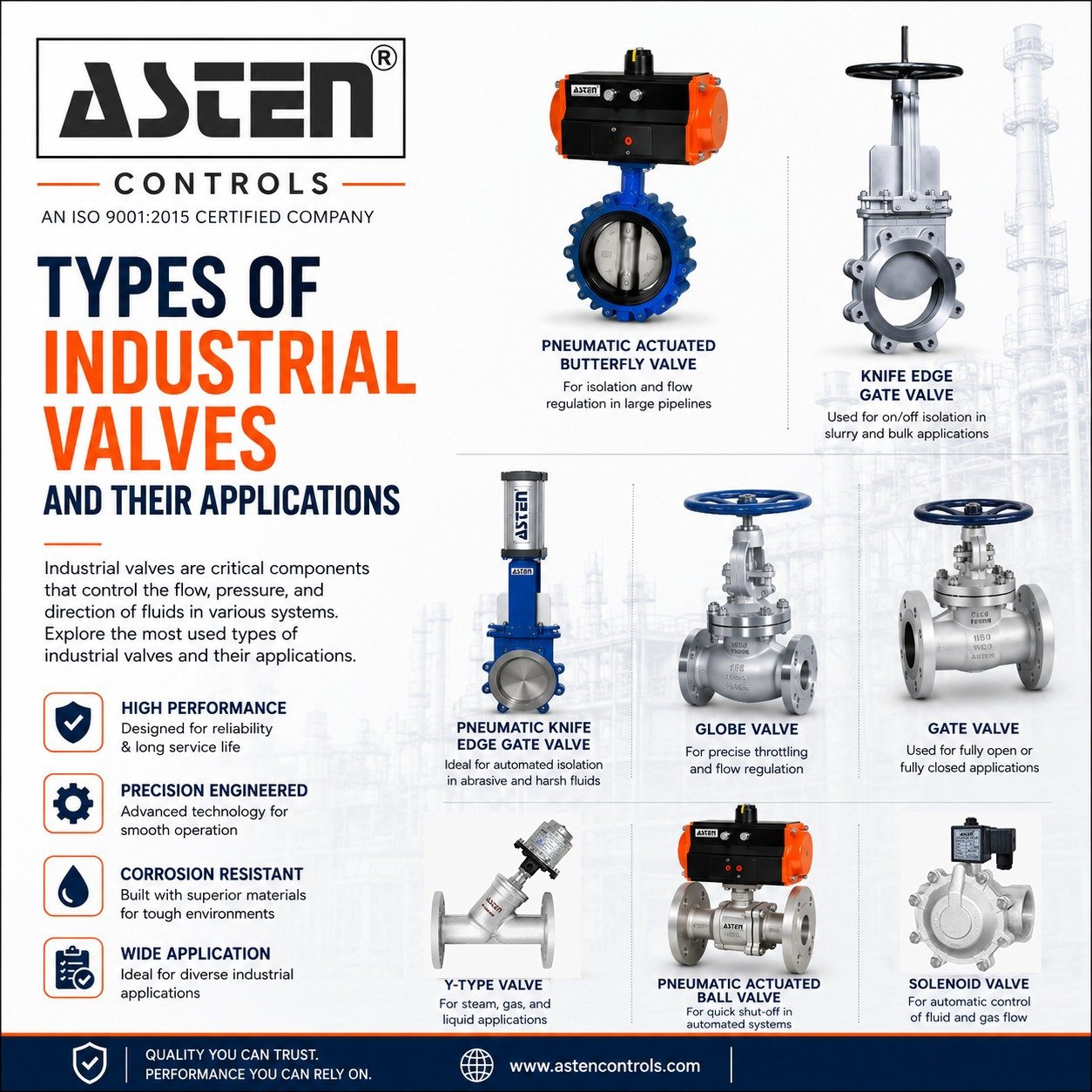
Types of Industrial Valves and Their Applications
DescriptionIndustrial Valve Types
Industrial valves are essential components in modern industrial systems, helping regulate, control, direct, and isolate the flow of liquids, gases, and other process media. Different types of industrial valves are designed for specific operating conditions and applications. Industrial valves can be found in water treatment plants, chemical processing plants, oil and gas companies, power plants, and manufacturing plants where they play significant roles in the processes in which they are used. Understanding their features, working principles, and uses helps industries select the right valve for efficient and reliable process control.
What Is an Industrial Valve?
An industrial valve is a mechanical device used to control, regulate, direct, or stop the flow of liquids, gases, and other process media within piping systems. Different valve designs are selected based on factors such as pressure, temperature, flow requirements, and the type of media being handled.
How Do Industrial Valves Work?
Industrial valves control flow by opening, closing, or partially restricting a passage within a pipeline. Depending on the valve design, operation may involve a disc, ball, gate, plug, or other internal component, which can be operated manually or through pneumatic, electric, or hydraulic actuators.
Why Are Industrial Valves Important?
Industrial valves help maintain safe, efficient, and controlled operation of industrial processes. They are essential for flow isolation, pressure and flow regulation, equipment protection, and system maintenance across industries such as oil and gas, chemical processing, power generation, water treatment, pharmaceuticals, and manufacturing.
Different Types of Valves and Their Applications
Ball Valves
Ball valves consist of a rotatable ball with a hole through which the flow of media passes to control or isolate. These valves are widely applied for their fast shut-off capabilities.
Common valve applications are: Water systems, chemical processing, oil & gas piping, compressed air systems and many others. Ball valves come in one piece, two pieces and three pieces.
Butterfly Valves
Butterfly valves feature a rotating disk to control or isolate the flow. The small size of the butterfly valves makes them ideal for applications involving large diameter pipes.
They are used in water purification, heating, ventilation and air conditioning (HVAC), chemical processing facilities, food processing and other fluid handling industries. Some butterfly valves may serve as regulating valves depending on their design.
Gate Valves
Gate valves are typically intended for isolation purposes. The valve uses a gate-like mechanism to regulate the opening or closing of the fluid path.
The gate valves usually work well in processes where the valve will need to be fully open or completely closed.
Applications include pipelines with water, oil, steam and other media used in various industries.
Globe Valves
The globe valves are common in processes where regulated flow is necessary. The internal design of the valve allows the flow to be adjusted more precisely than many of the isolation valves.
Applications include steam systems, cooling systems and process lines requiring throttling and control of flow.
Check Valves
The check valves allow the flow in one direction and prevent flow in the opposite direction. They are automatic in nature, and there is no need for manual adjustment.
They are commonly found after the pump and in the process where backflow may damage some equipment.
Plug Valves
The plug valves have a plug with a passage in it which controls the flow. It provides a shut-off valve, and it works with different types of liquids, gases and chemical media.
Diaphragm Valves
In diaphragm valves, the flow of media is regulated by means of a flexible diaphragm. Since the actuation of the valve is separable from the process fluid, they are ideal for corrosive, abrasive or high purity fluid services.
They find application in chemical processing, water treatment, pharmaceutical and food-related applications.
Knife Gate Valves
Knife gate valves are especially suited for slurries, thick liquids and other similar fluids. They help in cutting certain solid-containing material during the process of actuation.
They are some of the commonly employed valves in industries such as mining, paper & pulp, waste water treatment and slurry handling plants.
Automated and Actuated Valves
Most of the industrial valves used for regulating flow can also be operated in an automated fashion through actuators such as pneumatic, electrical or hydraulic ones. Automated valves have application in scenarios requiring remote operation or cyclic operation of valves.
They find common application in industries like process automation, manufacturing plants and water treatment plants among others.
Industrial Valve Applications by Industry
Industrial valves are used across diverse industries to control, isolate, and regulate the flow of liquids, gases, and process media. The right valve type depends on the industry’s operating conditions, media, pressure, temperature, and process requirements.
Oil & Gas Industry
Industrial valves are used for controlling and isolating oil, gas, and other process fluids across pipelines, refineries, storage facilities, and processing plants.
Chemical & Petrochemical Industry
Valves help manage corrosive, hazardous, and high-temperature media while providing reliable flow control and process isolation.
Water & Wastewater Treatment
Valves regulate water flow and support isolation, treatment, filtration, pumping, and distribution systems in water and wastewater facilities.
Power Generation
Industrial valves are used in steam, cooling water, fuel, and other process systems to control flow and support safe and efficient power generation.
Pharmaceutical Industry
Valves help maintain controlled and hygienic process conditions in pharmaceutical manufacturing, fluid handling, and clean utility systems.
Food & Beverage Industry
Industrial valves control the movement of water, ingredients, cleaning solutions, and other process fluids while supporting hygienic production requirements.
Steel & Metal Industry
Valves are used in cooling water, gas, hydraulic, and other process systems involved in steel and metal production.
Mining & Minerals
Industrial valves help control water, slurry, air, and other process media used in mineral processing and mining operations.
Paper & Pulp Industry
Valves regulate water, chemicals, steam, pulp, and other process fluids throughout paper and pulp manufacturing systems.
Benefits of Using the Right Industrial Valve
Choosing the correct valve is essential to having an effective, safe and reliable industrial process. A good industrial valve may provide your process with various benefits.
Improved Flow Control
There are various flow control valves that control, direct and isolate the flow of the media. Choosing the right valve based on the flow characteristics will provide you with improved flow control over your process.
Better Process Efficiency
When an appropriate valve is used, the need for pressure losses can be avoided, thus providing for better process efficiency.
Reduced Leakage
Each industrial valve comes with its own type of sealing that depends on the application of the valve. The right choice of a valve and material may provide reduced leakage.
Protection of Equipment
An appropriate valve provides protection for equipment such as pumps, pipelines, tanks and others from problems such as backward flows, high pressure and uncontrolled flows of liquids. For example, backflow prevention can be provided by using check valves while pressure-control valves are applied to deal with operating pressure.
Less Maintenance
Appropriate valves provide for less maintenance needs because of less premature wear. Material, sealing and valve design are very important when dealing with corrosive, abrasive or high-temperature media.
Enhanced Operational Safety
Conditions in industrial systems are always tough. Appropriate valves help control processes and media in the industrial system.
Longer Service Life
A valve that is designed and constructed according to the application’s pressure, temperature, and media may result in higher reliability, thus increasing its service life, reducing the frequency of valve replacement.
Asten Controls – Industrial Valve Manufacturer in India
Asten Controls defines itself as a leading industrial valve manufacturer in India, which supplies industrial valve and automation solutions to its customers. Asten Controls has established their operation since 2008 and its manufacturing operations are based in Ahmedabad.
Being an industrial valves manufacturer, Asten Controls provides industrial valves for a wide variety of categories. Its product line includes industrial valves and automation equipment that are able to provide process isolation, flow regulation, automation and efficient fluid transportation.
In terms of its manufacturing, the company puts emphasis on engineering accuracy and quality. The appropriate production and testing processes are essential for providing reliable operation of the industrial valves under certain operating conditions.
Frequently Asked Questions about Industrial Valves
What is the difference between a ball valve and a butterfly valve?
The ball valve has a rotating ball as the means of controlling the flow and is widely used for quick shut-off and isolation purposes. The butterfly valve has a rotating disc and is widely preferred for large diameter pipes because of its compact structure.
What valve prevents backflow?
A check valve is a valve that prevents backflow. It lets media pass in only one direction and automatically restrains reverse flows.
Which valve is used for slurry services?
The knife gate valves are most suitable for the slurry and solid containing fluids. In accordance with slurry characteristics, special types of valves can also be required.
What are the important considerations in choosing an industrial valve?
Among the most important are the fluid type, pressure, temperature, flow, valve function, material compatibility, pipeline size and manual/automated valve operation.
What is the difference between manual and automated valves?
The manual valves are actuated manually by a lever, hand wheel or other device. The automated valves are controlled automatically by an electric, pneumatic or hydraulic actuator.
Which industries apply industrial valves?
Some of the industries that make use of industrial valves include oil and gas industry, water treatment plants, chemicals industry, pharmaceuticals industry, food processing industry, power generation, mining, pulp and paper industry, manufacturing and HVAC systems.
Conclusion
Knowing the types of industrial valves and the uses to which they are put helps in selecting the correct type of valve for any process in industry. No one valve will suffice in all cases. Ball valve is the best choice for rapid isolation and globe valve suits better for regulation purposes. The check valves ensure that the backward flow does not happen, and the knife gate valves find their use in slurry processes.
The deciding factor for choosing the valve will involve aspects like process fluid, operating pressure, operating temperature, flow requirement, valve purpose, material compatibility, line size and mode of operation.


